
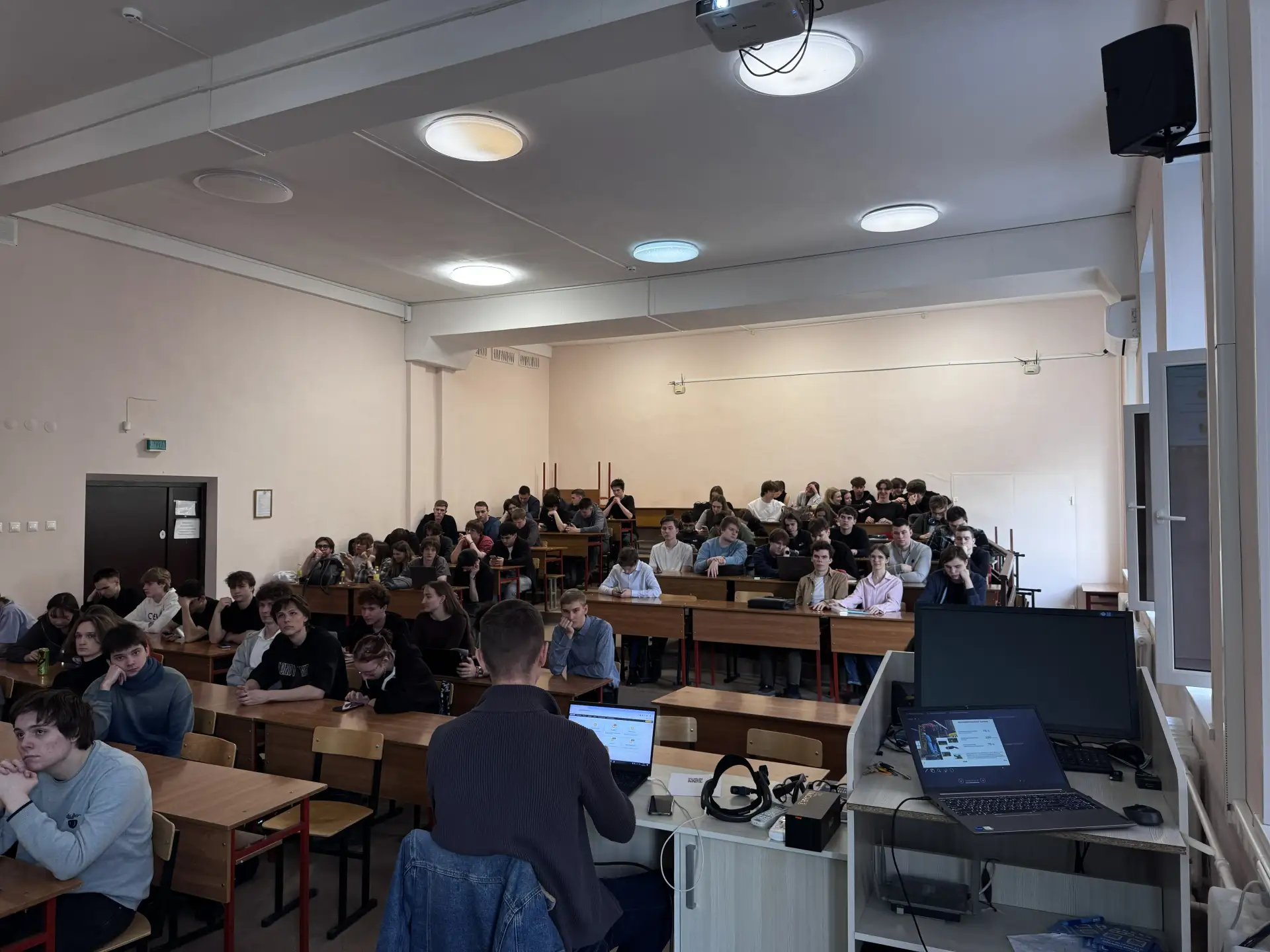
On April 16, 2026, a meeting was held at Voronezh State University between students and faculty of the Faculty of Computer Science and the IKSAR team to discuss current trends in augmented and extended reality technologies combined with artificial intelligence (AR/XR + AI).
The IKSAR team has been actively developing augmented reality solutions for industry in Russia since 2017. The IKSAR product is built on collaboration with more than 100 enterprises across various sectors, including oil and gas, energy, mechanical engineering, mining, construction, transport, and agriculture.
Around 70–80% of the global workforce operates on-site and “in the field” with minimal digitalization. Increasingly complex equipment, shift work, hazardous conditions, and a lack of information and expertise to solve critical problems lead to low productivity, poor operational efficiency, and high costs. The situation is further aggravated by a growing shortage of qualified personnel, ranging from 30% to 50% depending on the industry and profession.
Augmented Reality (AR), or as it is now often referred to, Extended Reality (XR), is one of the key technologies of Industry 4.0/5.0 for human-involved industrial processes. It has a decisive impact on improving productivity, speed, safety, quality, transparency, and reducing costs.
In the first part of the meeting, IKSAR representatives demonstrated with concrete facts and figures that AR/XR technologies are a significant component of advanced Industry 4.0/5.0 solutions. The global AR market in 2024 was estimated at $50–80 billion, with projected annual growth of around 35% from 2025 to 2030. The United States (~31%) and China (~12.7%) together account for nearly half of the global market. More than 60% of U.S. Fortune 500 companies are already implementing or testing AR/XR technologies. China leads in both the number of newly released AR glasses (35 out of approximately 140) and sales, having moved from the “4 AR Tigers” in 2023 to the beginning of the “Battle of 100 Glasses” in 2026 meaning around 100 Chinese companies are now competing for leadership in AR device manufacturing. In Europe, Germany holds a strong leading position driven by large-scale industrial deployments (BMW, Volkswagen, Mercedes-Benz, Siemens, BASF, and others). In the Middle East, Saudi Arabia has entered the race by launching an Industry 4.0 center based on Saudi Aramco (4IRC, The Fourth Industrial Revolution Center) and adopting a strategic AR+AI program for sustainable development.
In the second part of the meeting, technical experts conducted a live demonstration of IKSAR’s advanced software platform, combining multiple technologies (AR, NLP, CV, ML, AI) in a simulated industrial process. Workers receive step-by-step instructions through AR glasses, keeping their hands free, while all interactions are controlled by voice. Using computer vision and real-time AI processing, employee actions, surrounding objects, and events can be instantly analyzed and interpreted.
No other technology provides such a clear first-person view of industrial workforce activities. AR data effectively becomes a kind of digital DNA for industry, forming a foundation for future robotics.
IKSAR holds a leading position in the Russian market and has the most extensive practical implementation experience, with use cases across 12 industries and more than 100 companies.
For students, it was especially valuable not only to learn about theoretical market trends and technology capabilities, but also to see real-world implementations in Russia and understand how these technologies are applied in practice and how they benefit people and businesses.
In the final part of the meeting, participants were invited to test IKSAR software and several models of AR glasses from different manufacturers, including RealWear Arc 3, Navigator 520, Goolton G520, C3000, H4000, and INMO Air 3.
The meeting concluded with a Q&A session involving more than 70 participants.
The IKSAR team expressed gratitude to the Dean of the Faculty of Computer Science at VSU for the invitation and looks forward to continued collaboration with the university across multiple areas.
The IKSAR team has been actively developing augmented reality solutions for industry in Russia since 2017. The IKSAR product is built on collaboration with more than 100 enterprises across various sectors, including oil and gas, energy, mechanical engineering, mining, construction, transport, and agriculture.
Around 70–80% of the global workforce operates on-site and “in the field” with minimal digitalization. Increasingly complex equipment, shift work, hazardous conditions, and a lack of information and expertise to solve critical problems lead to low productivity, poor operational efficiency, and high costs. The situation is further aggravated by a growing shortage of qualified personnel, ranging from 30% to 50% depending on the industry and profession.
Augmented Reality (AR), or as it is now often referred to, Extended Reality (XR), is one of the key technologies of Industry 4.0/5.0 for human-involved industrial processes. It has a decisive impact on improving productivity, speed, safety, quality, transparency, and reducing costs.
In the first part of the meeting, IKSAR representatives demonstrated with concrete facts and figures that AR/XR technologies are a significant component of advanced Industry 4.0/5.0 solutions. The global AR market in 2024 was estimated at $50–80 billion, with projected annual growth of around 35% from 2025 to 2030. The United States (~31%) and China (~12.7%) together account for nearly half of the global market. More than 60% of U.S. Fortune 500 companies are already implementing or testing AR/XR technologies. China leads in both the number of newly released AR glasses (35 out of approximately 140) and sales, having moved from the “4 AR Tigers” in 2023 to the beginning of the “Battle of 100 Glasses” in 2026 meaning around 100 Chinese companies are now competing for leadership in AR device manufacturing. In Europe, Germany holds a strong leading position driven by large-scale industrial deployments (BMW, Volkswagen, Mercedes-Benz, Siemens, BASF, and others). In the Middle East, Saudi Arabia has entered the race by launching an Industry 4.0 center based on Saudi Aramco (4IRC, The Fourth Industrial Revolution Center) and adopting a strategic AR+AI program for sustainable development.
In the second part of the meeting, technical experts conducted a live demonstration of IKSAR’s advanced software platform, combining multiple technologies (AR, NLP, CV, ML, AI) in a simulated industrial process. Workers receive step-by-step instructions through AR glasses, keeping their hands free, while all interactions are controlled by voice. Using computer vision and real-time AI processing, employee actions, surrounding objects, and events can be instantly analyzed and interpreted.
No other technology provides such a clear first-person view of industrial workforce activities. AR data effectively becomes a kind of digital DNA for industry, forming a foundation for future robotics.
IKSAR holds a leading position in the Russian market and has the most extensive practical implementation experience, with use cases across 12 industries and more than 100 companies.
For students, it was especially valuable not only to learn about theoretical market trends and technology capabilities, but also to see real-world implementations in Russia and understand how these technologies are applied in practice and how they benefit people and businesses.
In the final part of the meeting, participants were invited to test IKSAR software and several models of AR glasses from different manufacturers, including RealWear Arc 3, Navigator 520, Goolton G520, C3000, H4000, and INMO Air 3.
The meeting concluded with a Q&A session involving more than 70 participants.
The IKSAR team expressed gratitude to the Dean of the Faculty of Computer Science at VSU for the invitation and looks forward to continued collaboration with the university across multiple areas.